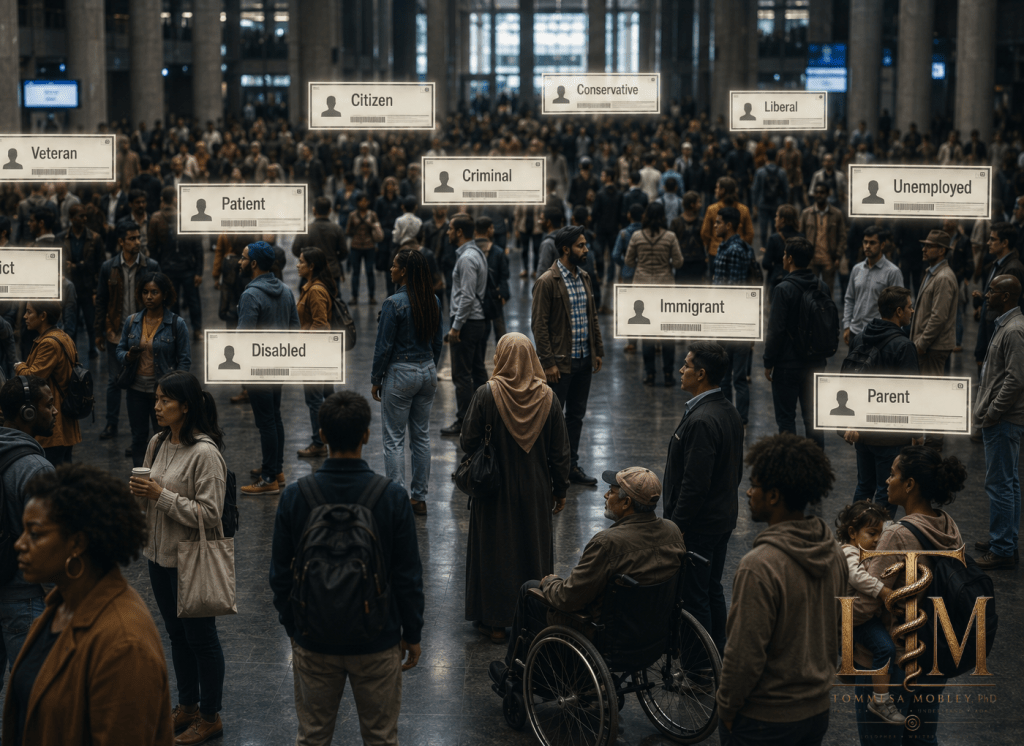
Governments rely on classifications. They always have. Classifications allow institutions to process large numbers of people efficiently, establish rules that can be broadly applied, and make decisions without evaluating every individual circumstance.
From a bureaucratic perspective, this makes perfect sense. Human beings are complicated. Administrative systems are not. The larger the institution, the stronger the temptation to reduce complexity into something that can be organized, measured, and managed.
Problems arise when classifications stop describing people and begin defining them.
A label can be useful as a shorthand. It can communicate information, identify patterns, and assist in decision-making. But there is a difference between using a designation as a tool and treating it as evidence. Once that line is crossed, a classification ceases to be descriptive and becomes predictive. Assumptions begin to attach themselves to the label, and eventually those assumptions become difficult to separate from the person.
This tension sits at the center of the Supreme Court’s recent decision in United States v. Hemani. Although the case concerns cannabis consumers and firearm ownership, the larger issue before the Court was whether membership in a particular group is sufficient justification for the loss of a constitutional right. In rejecting the federal government’s argument, the Court did more than weigh in on cannabis policy.
It challenged the notion that a citizen may be stripped of a constitutional protection based upon assumptions attached to a designation rather than evidence tied to individual conduct.
For decades, federal law treated marijuana consumers as a prohibited class of firearm owners. The reasoning appeared straightforward enough. Marijuana remained illegal under federal law, and those who used it were presumed to present a greater risk than those who did not. The designation carried the inference. Once a person was identified as a marijuana user, additional questions were often considered unnecessary.
The Court was not persuaded.
In a unanimous decision, the justices rejected the government’s effort to automatically equate marijuana use with a sufficient basis for disarmament. The ruling did not eliminate every firearm restriction, nor did it declare cannabis use harmless. Instead, it questioned whether the state may rely upon broad assumptions about an entire population when restricting a constitutional right.
The distinction is more significant than it may initially appear.
The question before the Court was never whether harmful people exist. Of course they do. Every society must grapple with violence, recklessness, and genuine threats to public safety. The more interesting question is how those threats are identified. What standard of evidence should be required before a citizen is viewed as sufficiently risky to justify the restriction of a constitutional protection?
This is where institutions often reveal their deepest instincts.
Individual evaluation is difficult. It requires context, evidence, nuance, and judgment. Administrative classifications are far more efficient. They allow governments, corporations, insurers, schools, and bureaucracies to make decisions at scale.
Human beings become data points.
Complexity becomes paperwork.
Ambiguity becomes a checkbox.
One of the peculiar habits of modern institutions is their belief that a sufficiently detailed form can capture a human being. Given enough boxes, enough codes, enough classifications, the individual eventually becomes legible to the system. What often gets lost in the process is that people are rarely as simple as the paperwork designed to describe them.
- The cannabis consumer.
- The criminal.
- The addict.
- The welfare recipient.
- The mentally ill.
- The extremist.
- The threat.
Different eras produce different designations, but the underlying process remains remarkably consistent. A group is identified. Certain characteristics become associated with that group. Over time those characteristics cease to be treated as possibilities and begin to function as expectations. Eventually, the person disappears beneath the narrative attached to the label.
Long before the question reached the Supreme Court, most Americans had already encountered this logic elsewhere. It appeared in workplace drug screenings, employment policies, housing restrictions, and countless other areas of public life. Cannabis consumers were not merely individuals who used a particular substance.They belonged to a recognized category, and that category carried consequences.
One of the more curious features of workplace drug testing is that it reveals how deeply classifications can become embedded within institutions.
Employers generally have no way of knowing who consumed alcohol last weekend and who consumed cannabis. Both behaviors are largely invisible unless someone goes looking for evidence of them. Yet for decades, many workplaces routinely searched for evidence of one and not the other.
The point is not that employers acted maliciously. Most were likely following established policies, legal guidance, insurance requirements, or industry norms. In many cases, the question was never even raised. That may be the most revealing aspect of all.
Classifications become most powerful when they stop appearing to be classifications.
What makes the Hemani decision interesting is not merely the cannabis question. It is what happens when an assumption that has largely escaped scrutiny is suddenly examined. For decades, the classification existed in the background, quietly shaping policy and public perception. Few people questioned it because it no longer appeared to be a judgment. It appeared to be common sense.
Then the Court essentially asked a simple question: Why are we assuming this?
Once that question is asked, the classification becomes difficult to ignore. What initially appears to be an isolated policy begins to look like part of a broader pattern. Categories acquire assumptions. Assumptions acquire authority. Authority eventually stops explaining itself.
The same process appears throughout human history. A group is identified. Characteristics become associated with that group. Those characteristics harden into expectations. Eventually, individuals are judged not solely by their conduct, but by the assumptions attached to the classification itself.
The particulars change. The mechanism remains remarkably consistent.
- Race.
- Sex.
- Sexual orientation.
- Religion.
- Disability.
- Political affiliation.
- Nationality.
- Cannabis users.
The classifications are not identical, and the consequences are not always the same. Yet the underlying process is often familiar.
A category begins as a description. Over time, it accumulates a narrative. Eventually, the narrative becomes so deeply embedded that few people stop to ask whether it still deserves to be believed.
This is where categories become dangerous.
Not because classifications are inherently wrong. Every society relies upon them to some extent. The danger emerges when a classification stops serving as a starting point for inquiry and becomes a substitute for inquiry itself. At that moment, assumptions begin doing the work that evidence was meant to do.
The Supreme Court’s decision in United States v. Hemani raises a question that reaches far beyond marijuana, firearms, or constitutional law. How much evidence should a free society require before it decides that a citizen deserves suspicion?
The answer matters because classifications are easy to create. Once created, they rarely remain confined to a single population. Eventually, every citizen discovers that somewhere, on someone’s form, they belong to a category.
The challenge is not to eliminate categories. The challenge is to remember that no category, however familiar, is ever a substitute for the individual standing in front of us.
If you enjoy thoughtful essays that explore consciousness, culture, neurodivergence, relationships, and the hidden structures shaping human experience, consider supporting my work.
Your support helps fund the time, research, and resources required to continue producing independent essays, reports, and educational content.
Thank you for reading.


Leave a Reply